Data preparation
Get real experimental data into a shape a model can use.
- Load CSV
- Filter rows
- Standardize
- Train/test split
One place where experimental data becomes a workflow, a workflow becomes a model, and every result can be traced back to the run that produced it.
What you can build
Every screen below is a real workflow or AI agent, not an illustration.
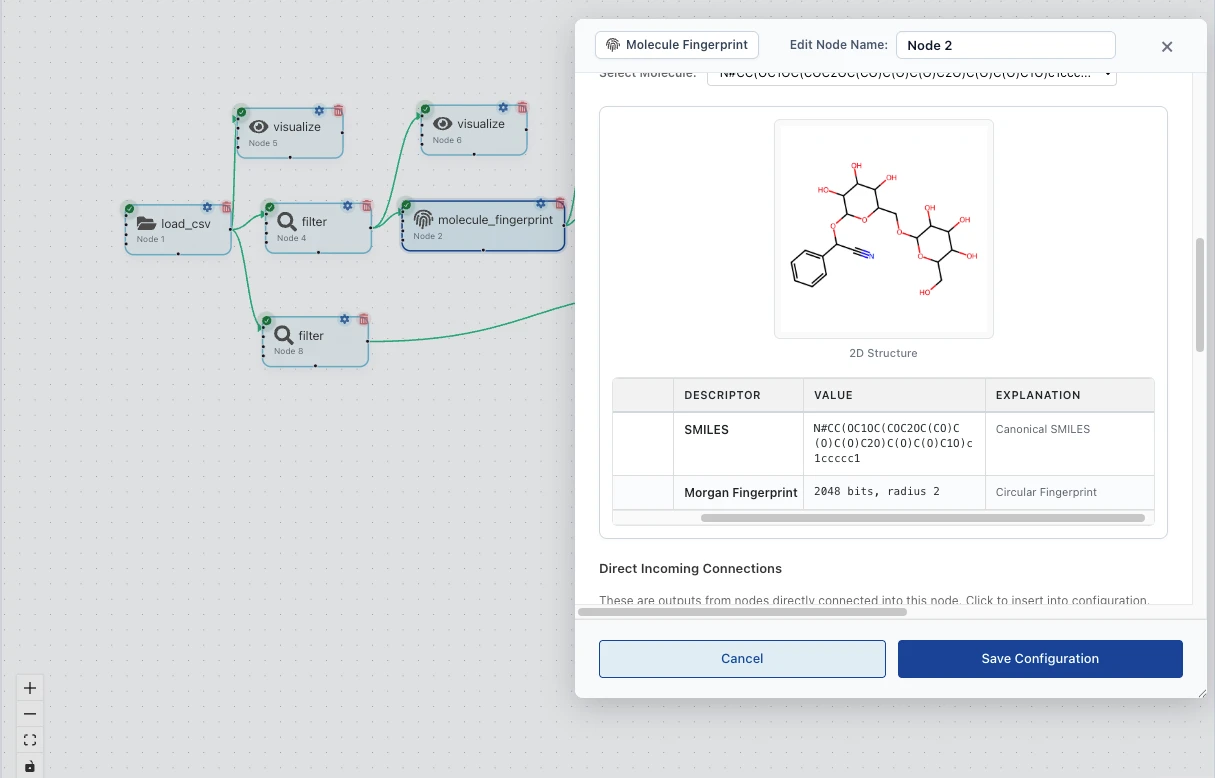
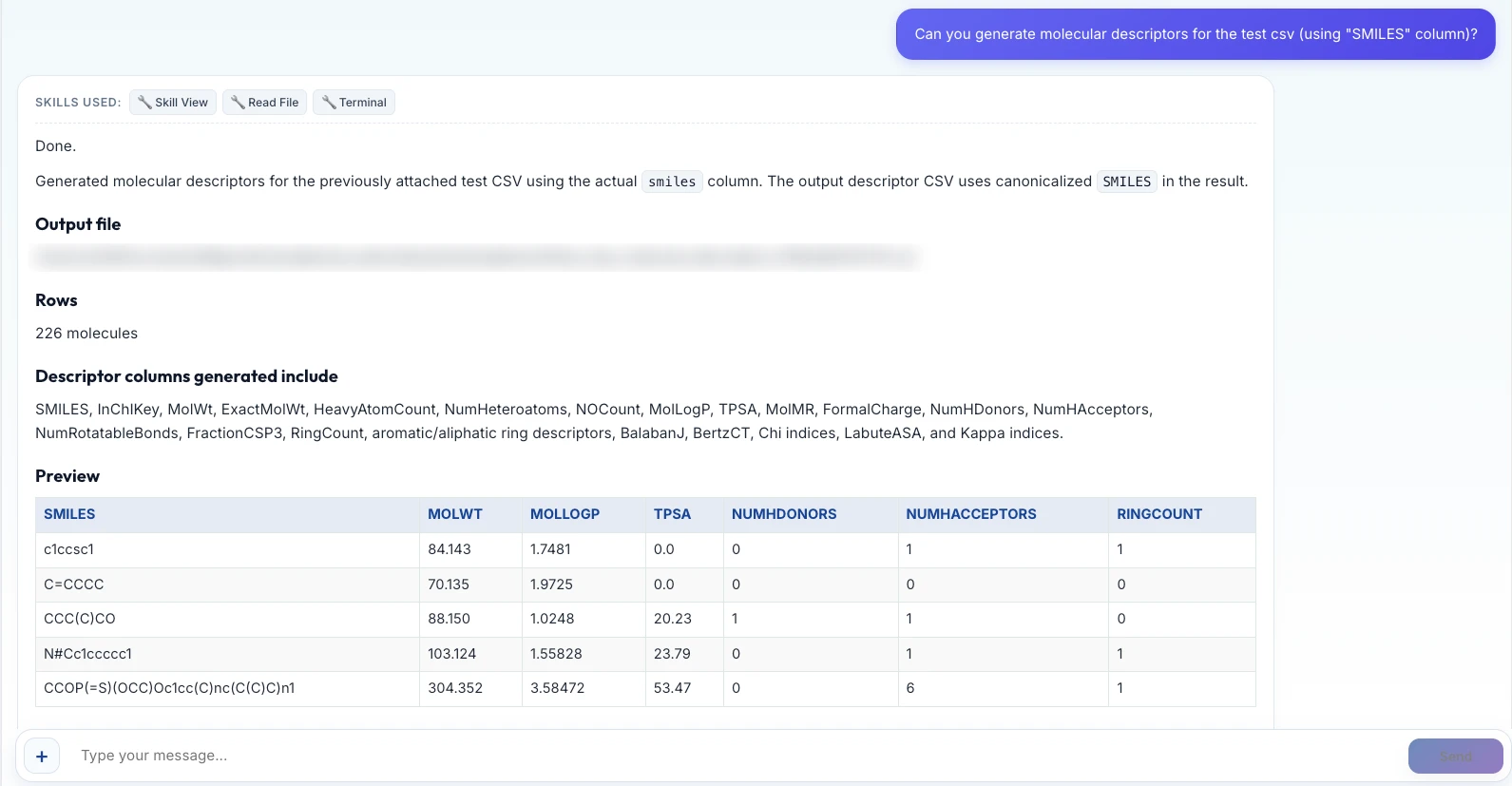
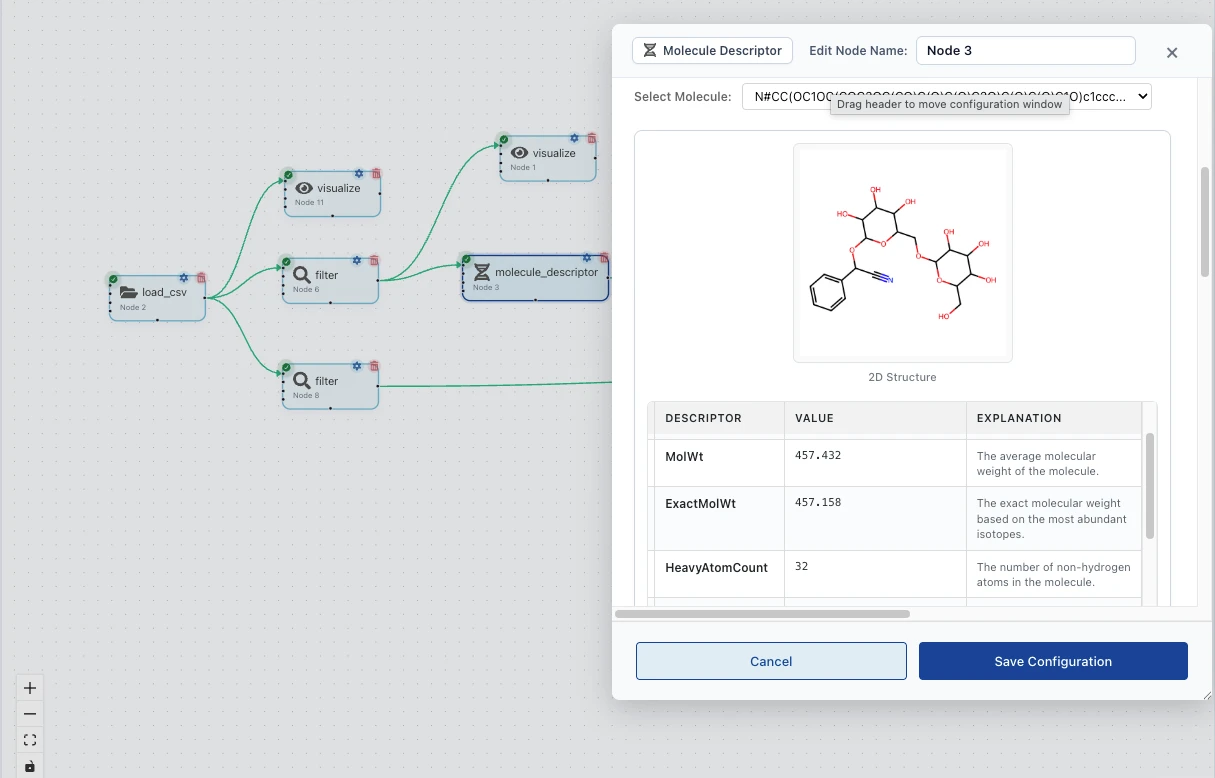
Go from a SMILES column to a trained model without leaving the workflow. Descriptors and fingerprints feed classical models; message-passing graph networks and 3D representations take over when structure carries the signal.
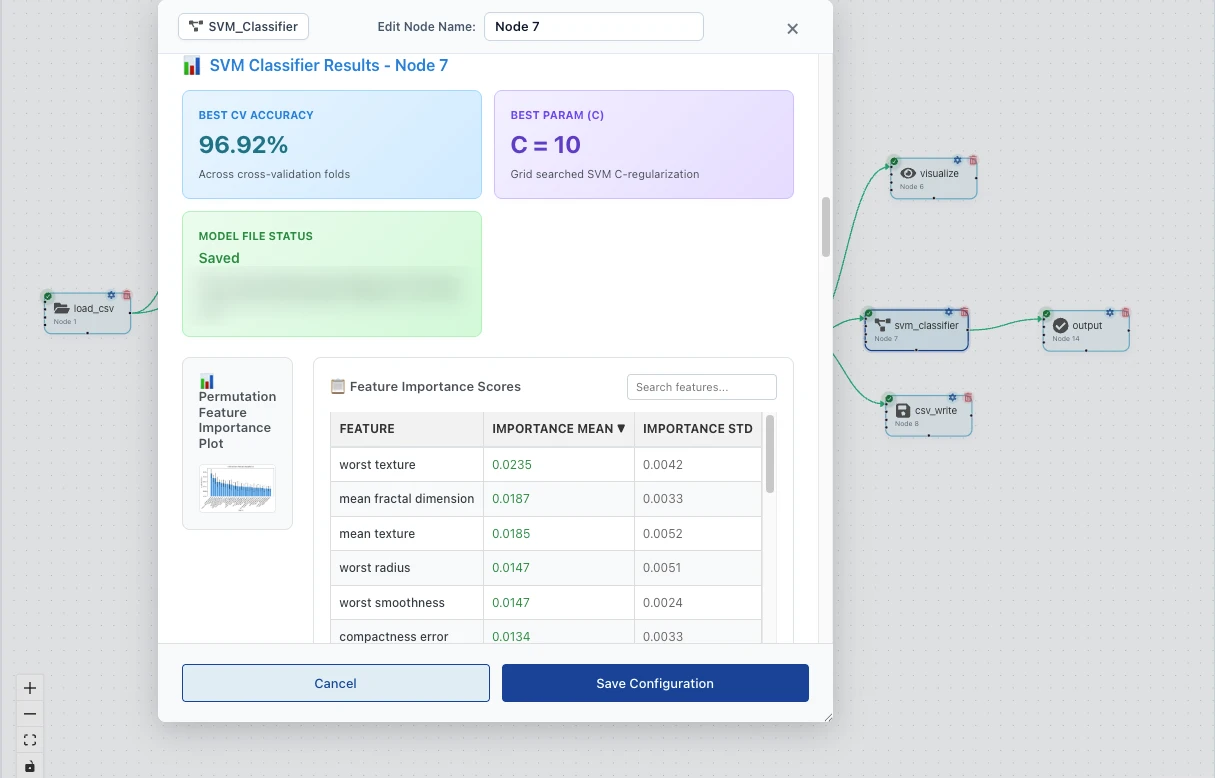
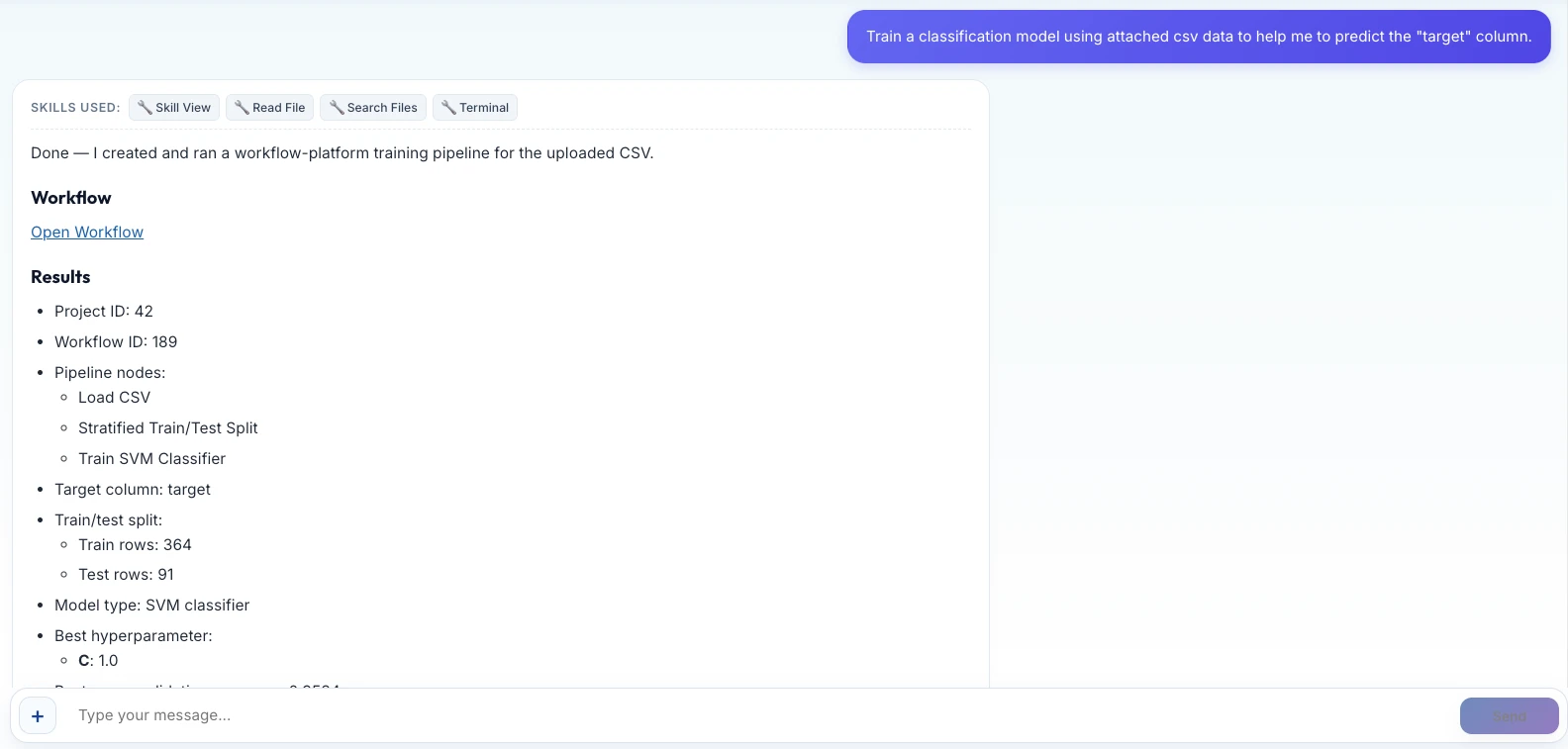
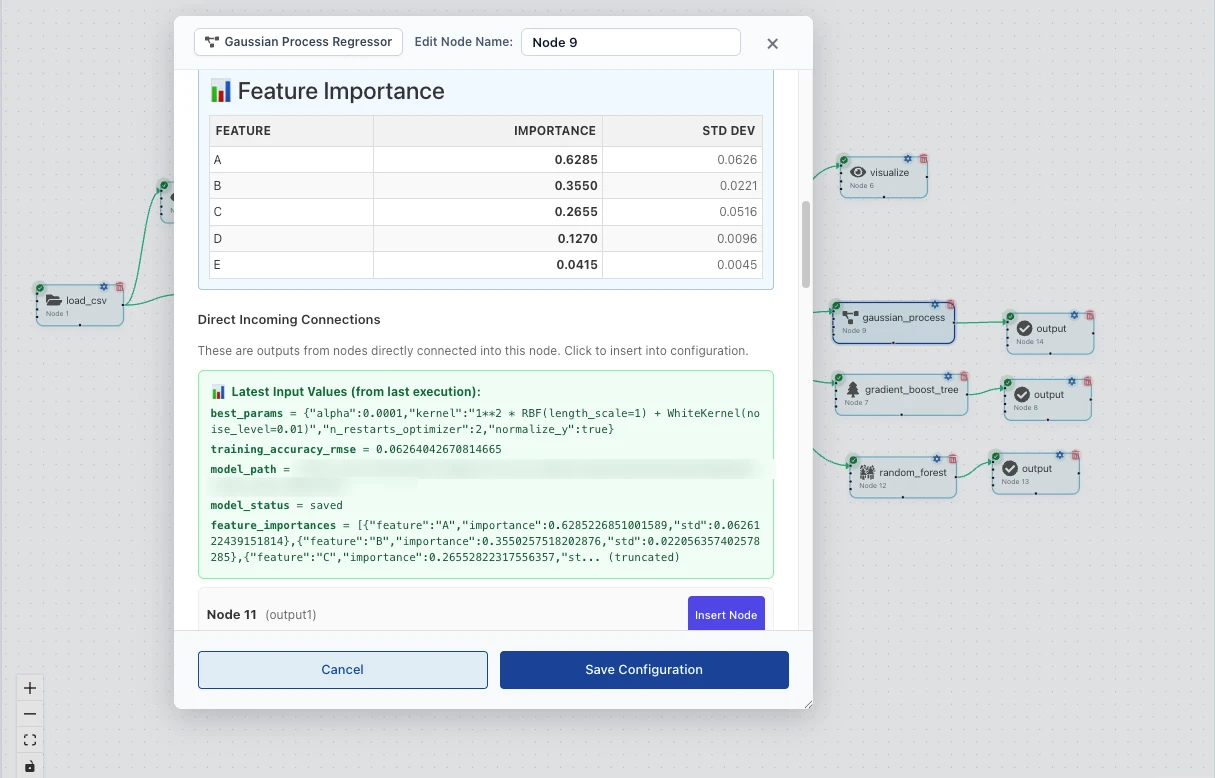
Train competing models against the same split and compare them honestly. Feature importance, cross-validated accuracy, and permutation scores are nodes in the workflow, so the comparison is recorded rather than reconstructed from memory.
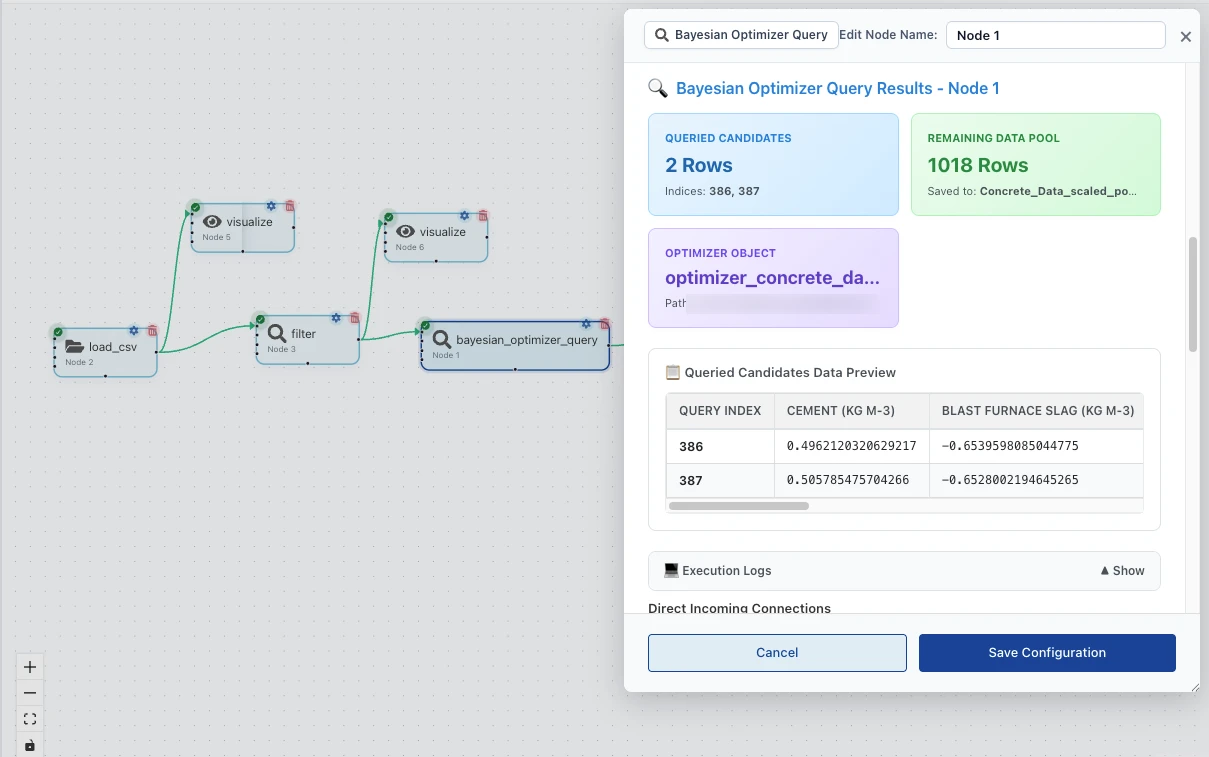
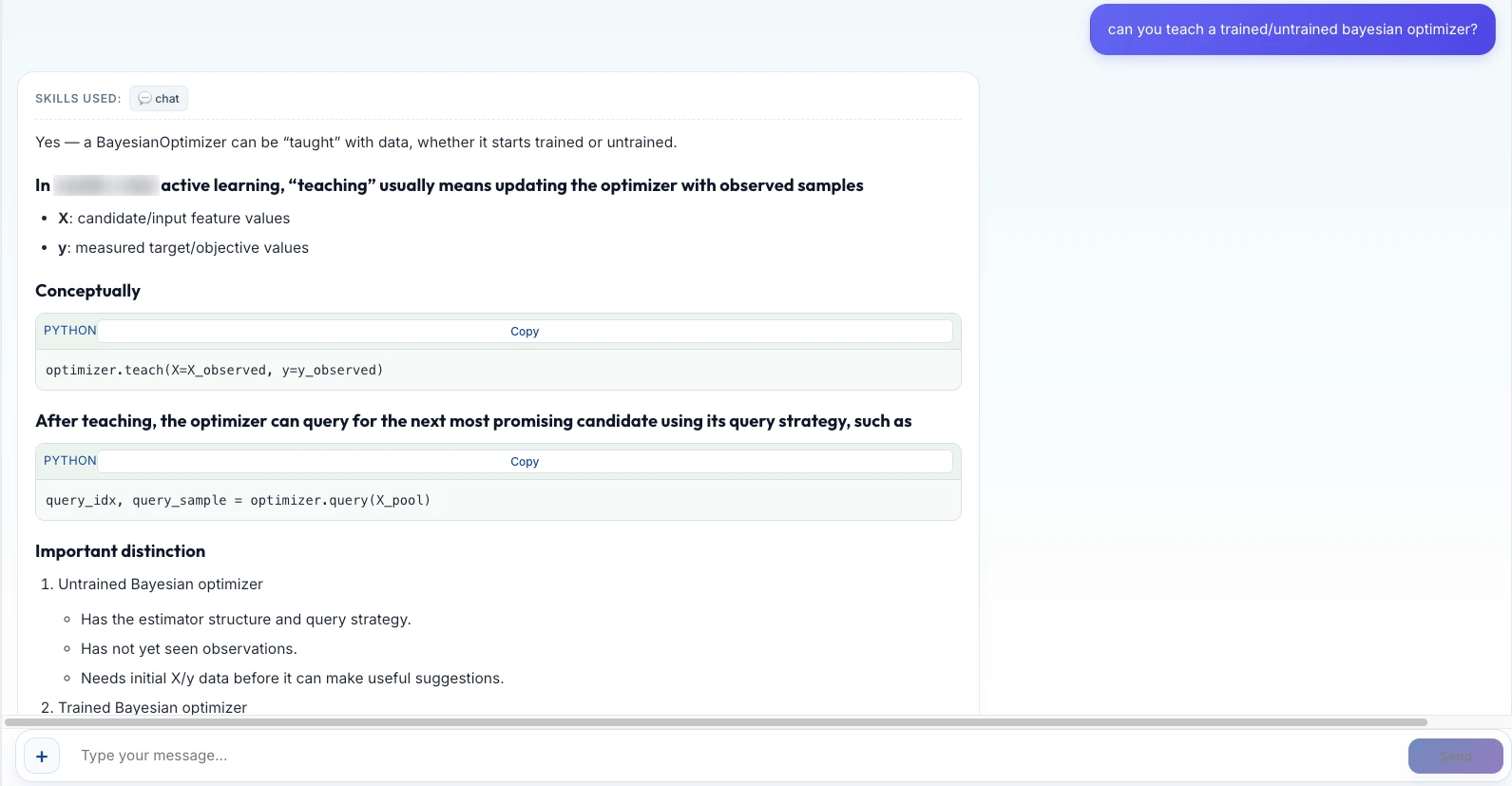
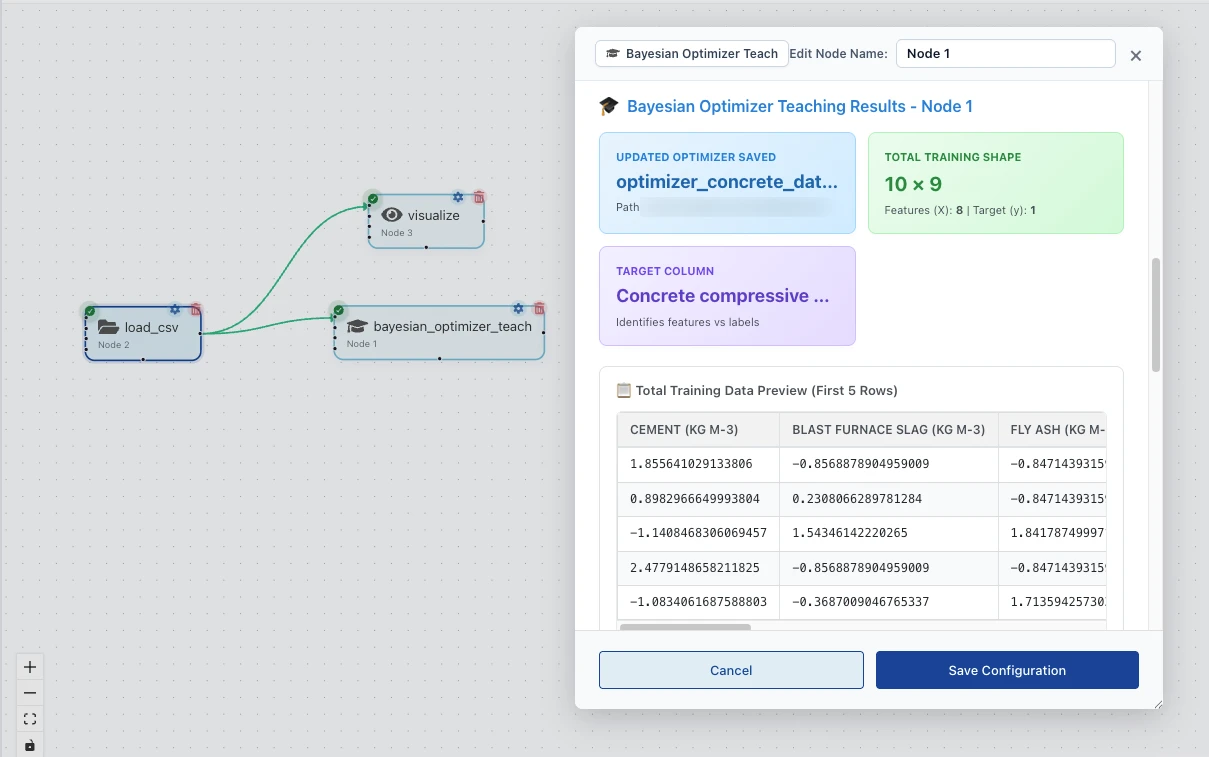
A loop, not a one-shot fit. Teach a surrogate what you have already measured, ask it which experiments to run next, then feed the results back. Acquisition by expected improvement, probability of improvement, or upper confidence bound.
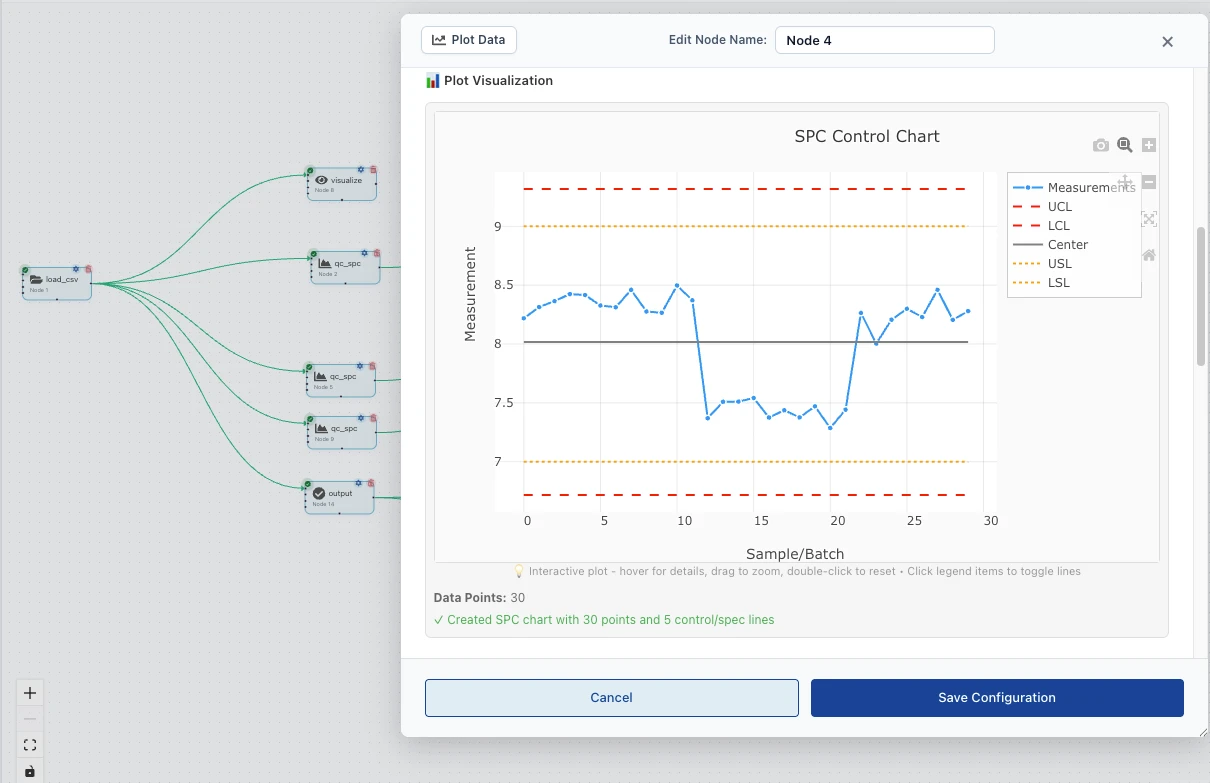
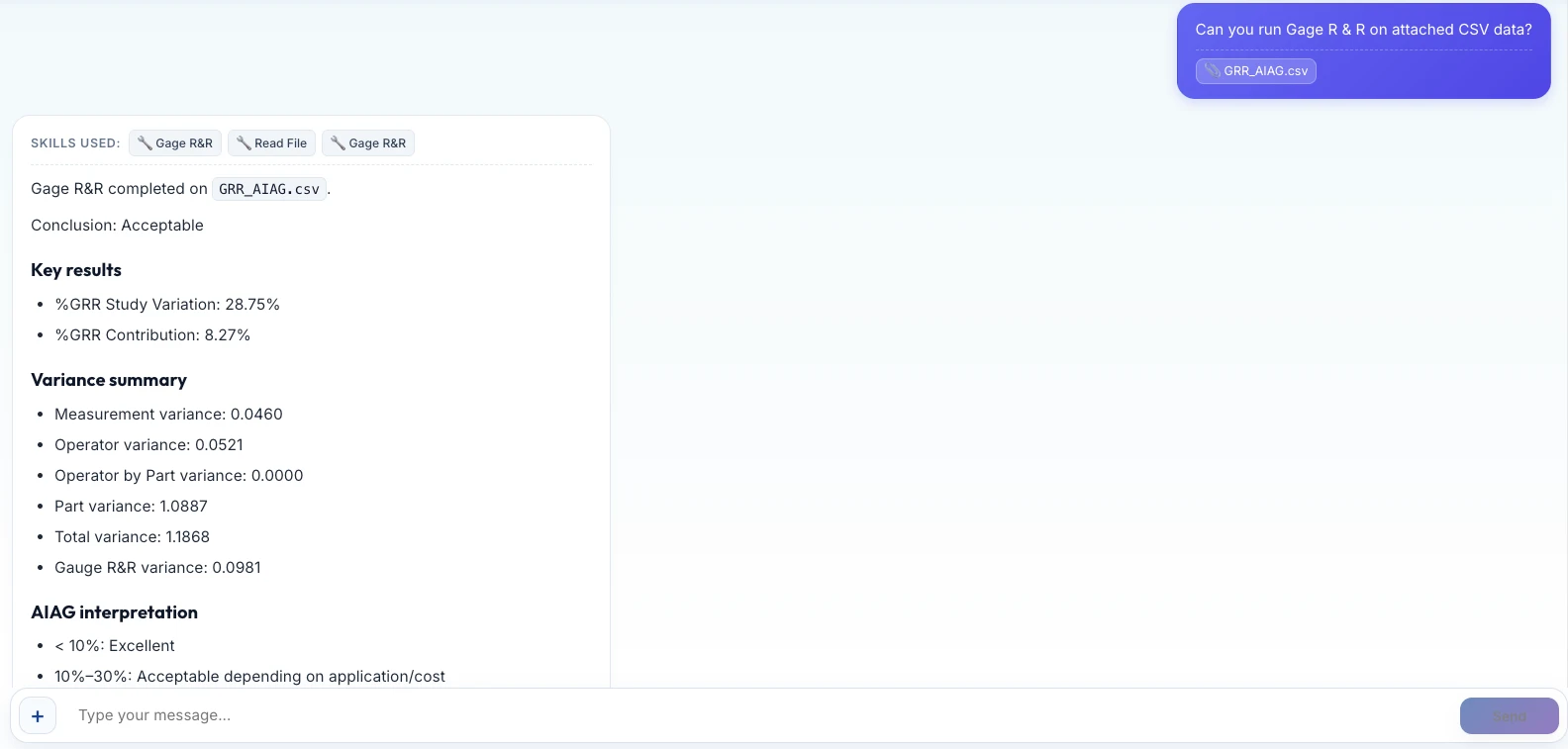
The methods a process engineer already reports. Gage R&R across operator, part, and trial with AIAG interpretation; control charts that flag rule violations against control and specification limits.
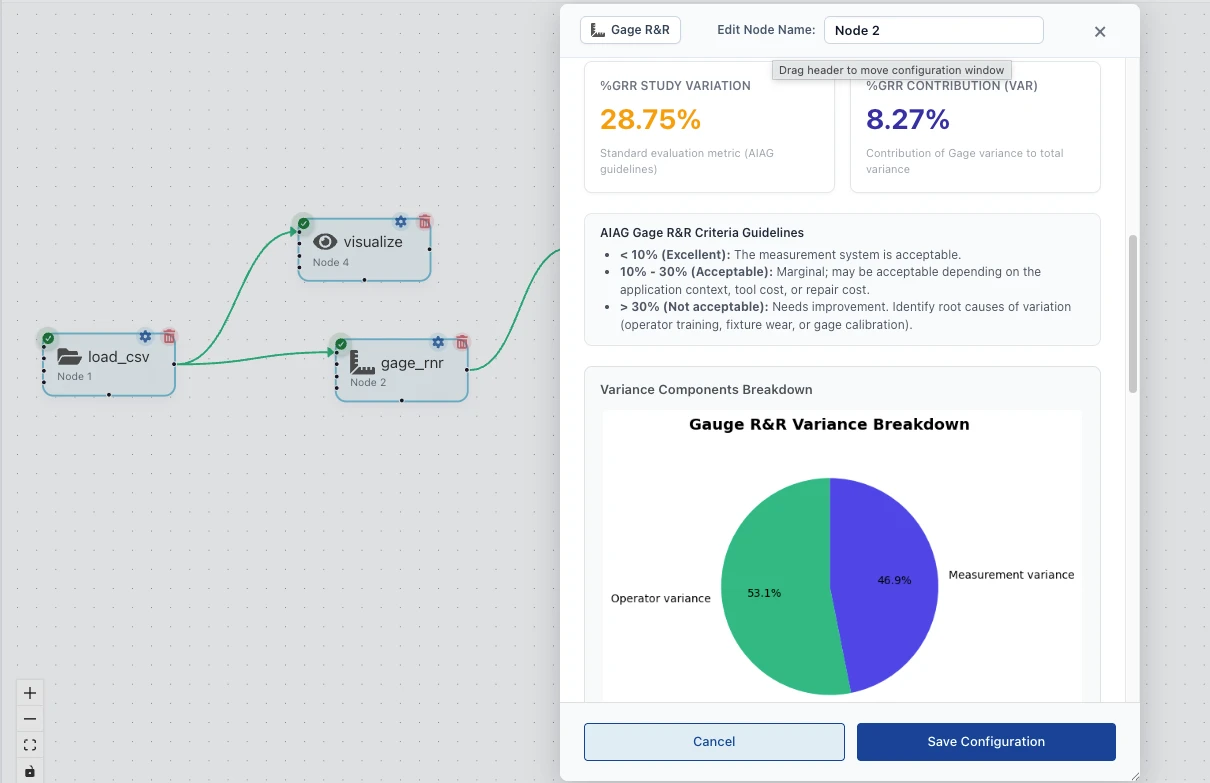
These are a sample of what teams have built, not the boundary of what the platform does — the node library below goes considerably further.
Node library
Not a framework you extend before it does anything — the methods R&D teams actually reach for, already built and configurable on the canvas.
Get real experimental data into a shape a model can use.
The methods process and measurement teams already trust.
Fit, score, and reuse models against experimental data.
Molecular and image models, trained or loaded from a checkpoint.
Turn structures and formulations into model-ready features.
See the structure in the data before committing to a model.
Close the loop: fit a surrogate, propose the next experiment, feed the result back.
Instrument output handled as a first-class input.
Agents that sit on the canvas as nodes, reading the run's data and passing their work on.
Where the platform stops guessing and you take over.
Node creation
The node library is not a fixed set. When the method you need is not there, you build it once as your own node — with an agent helping you write and test it — and from then on it sits on the canvas like every other node, and your agents can call it.
Start from a custom code node: declare its inputs, parameters, and outputs, then write the Python that does the work. An agent can draft and test it alongside you.
Turn the working node into a template. It joins the node list under a name you choose, ready to drop into any workflow.
Export it as an agent skill, and your agents can call it themselves as part of a run.
No ML engineer needed to get a first result. Bring the data and the scientific question — the workflow, the model, and the record come with it.
Full parameter control and your own saved models, with the run history kept for you instead of by you.
Gage R&R, SPC, and ANOVA in the same place as the models that use their output.
Working in
VanaNexus is in active development with a small group of design partners in materials, chemistry, and process engineering. Partners put it on real projects early and shape what gets built next.